A practical sequence for selecting, specifying, documenting and receiving Metong road equipment without relying on unverified catalogue assumptions.
Overseas procurement problems usually begin when the buyer asks for a price before the application, material and site constraints are defined. This guide organizes the information engineers need to compare equipment, prepare documents and plan delivery.

Separate new construction, preventive maintenance, pavement repair, asphalt production, binder processing, compaction, cleaning or special access work.
Compare the five published families and their categories before choosing a model. The family usually determines the main purchase questions.
Tank or hopper capacity, working width, chassis duty, heating or control system, power requirement and optional equipment are checked against the written requirement.
Closure window, road access, headroom, altitude, temperature, water or power supply, foundation space and local approval constraints.
Specification clauses, certificates, test records, commercial documents, origin certificates and any market-specific approval requirement.
Engineering returns a configuration proposal, relevant datasheet references and, where required, arrangement or foundation information for the project.
Assembly, functional checks, pre-delivery records and packing preparation are coordinated before shipment.
Confirm shipping mode, document set, startup guidance, training scope and a first-season spare-parts list.
| Equipment group | Typical machines | Confirm before quotation |
|---|---|---|
| Surface treatment vehicles | Chip sealers, distributors, slurry or micro-surfacing units and spreaders. | Binder type, aggregate or chip requirement, treatment width, chassis class, control type and whether fibre dosing is required. |
| Asphalt mixing plants | Batch plants, mobile plants, mixers and recycling-related equipment. | Programme output, mix designs, cold-feed arrangement, dryer and dust-control needs, power supply, foundation and module transport limits. |
| Bitumen processing | Rubberized, polymer-modified, emulsion and melting equipment. | Binder grade, production rate, modifier type, mill or shear requirement, heated storage, recipe control and finished-product use. |
| Compaction and paving | Rollers, pavers, slipform machines, milling and stabilization equipment. | Layer material, compacted lift, machine weight or paving width, screed type, grade control and the planned equipment sequence. |
| Cleaning and special vehicles | Sweepers, brooms and bridge-inspection access vehicles. | Duty cycle, mounting method, dust or water requirement, brush arrangement, platform reach, load capacity and local road clearance. |
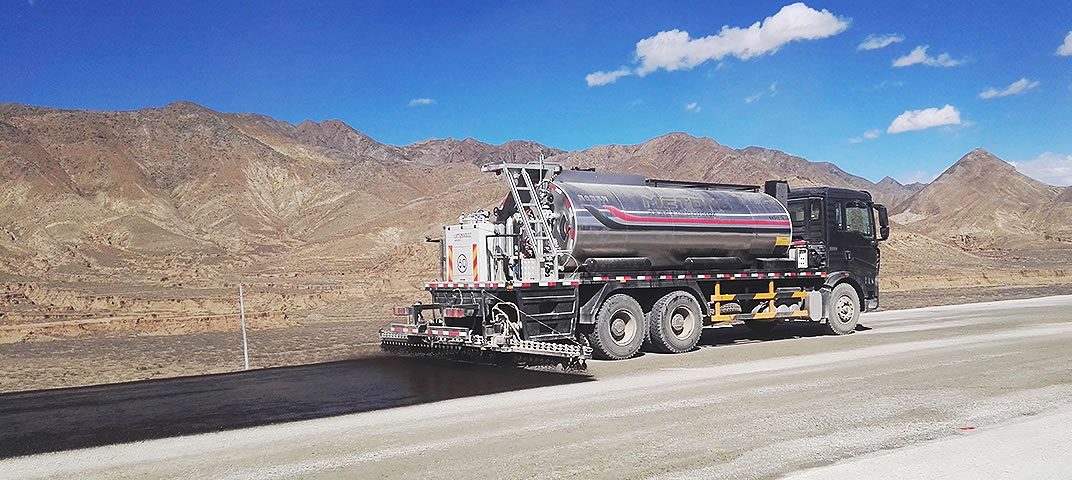
Start with the equipment family and category rather than a model number. Use the product catalogue filters, then send the application and output requirement; engineering returns the closest model direction and configuration questions.
The choice depends on mix-design changes, output continuity, fuel and environmental constraints. The technical note on batch versus drum plants explains the main selection criteria before the quotation stage.
Prepare the project application, material or mix requirement, output expectation, site conditions, destination port, required certificates and target delivery window. Existing tender documents can be sent directly with the enquiry.
A first-season list usually covers predictable wear items such as filters, seals, nozzles and wear components. The exact list depends on the confirmed model and expected operating hours; it should be discussed before shipment rather than requested after a failure.
Send the written requirement and any site photos or drawings. The enquiry becomes a custom-configuration discussion; final dimensions, capacities and options are confirmed in the proposal.
Arrangement drawings, foundation information and market-specific documents are project-specific. State the model, destination and site condition; engineering identifies which documents can be issued with the order.
Send the application, the material and the output you need. You will get a configuration proposal with capacity, chassis options and delivery window — not a catalogue page.