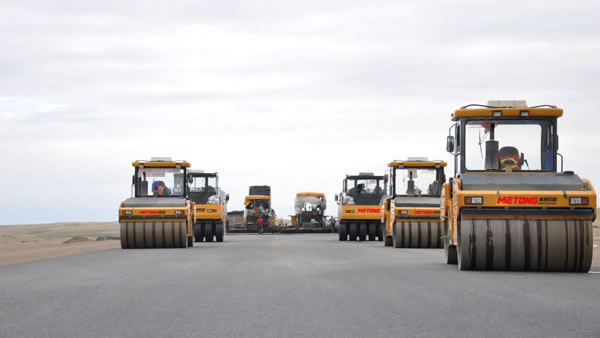
A compaction train is a sequence: breakdown, intermediate, finish. Each stage has a machine and a temperature window, and getting the order wrong produces a mat that is dense but uneven, or even but under-specified.
Breakdown
Breakdown follows the paver closely, while the mat is still hot and workable. A single-drum or heavy tandem roller with high amplitude at low frequency moves the material and removes most of the air voids. Waiting too long is the common failure: the mat cools, the roller rides on top, and density never arrives.
Intermediate and finish
Intermediate passes with a tandem roller at lower amplitude even out the surface and close the remaining voids. The finish pass with a pneumatic tyre roller is what produces the sealed, uniform texture — tyre kneading works the surface mortar rather than the aggregate skeleton. On dense-graded surface courses the tyre roller often does more for the appearance and permeability of the mat than the steel drum does.
Temperature, not just passes
The number of passes in a method statement assumes a mat temperature. On a cold day, or on a thin lift, the window closes faster and the specified pass count becomes unachievable. This is why competent crews watch the mat rather than the count, and why dual-frequency rollers — able to switch amplitude to suit lift thickness — are worth specifying.
Joints and edges
Most compaction failures found later are at joints. Tapering the joint, rolling from the hot side toward the cold, and using a smaller roller for edge work are what keep joint density close to mat density. A joint that is 3% below specification is where water enters.
Compaction · 5 min read