A conventional two-pass seal sprays binder from a distributor and then waits for a chip spreader to follow. In that gap the binder cools, dust settles on it, and traffic sometimes crosses it. The aggregate that arrives later sits on a film that has already started to set, so the bond is weaker than the specification assumes — the failure shows up as shelling and loose chips two winters later.
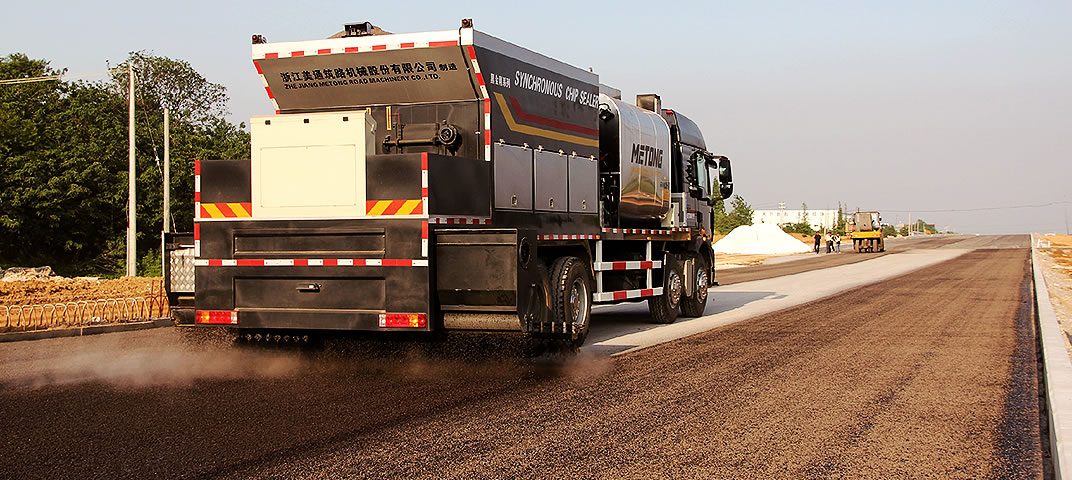
Synchronous sealing removes the gap. The spray bar and the aggregate spreader are on the same chassis, separated by a metre or two, and the chip is placed while the binder is still live. The seal that results is tighter, more uniform, and traffic can usually be released sooner because there is no loose chip to sweep.
How the rate is actually controlled
Binder application rate is the variable that decides whether a seal performs. Modern sealers derive it from ground speed and pump displacement rather than from a setting on a dial: the operator enters litres per square metre, the controller reads vehicle speed, and pump output is adjusted continuously. If the truck slows on a gradient, the pump slows with it — the rate stays the same.
This matters most on variable terrain and on short treatment lengths, which is exactly where two-pass work goes wrong. On a long, flat carriageway a constant-speed distributor can hold a rate by discipline alone; on a mountain road it cannot.
Where fibre enters the specification
Adding chopped glass fibre between binder and aggregate creates a stress-absorbing layer that resists reflection cracking from the pavement below. Fibre chip sealers meter fibre by weight per square metre alongside binder and chip, so the three materials are placed in one pass. This is the specification used on overlays over cracked concrete, and on high-wear junctions where conventional seals strip.
Specifying the machine, not the method
When a seal is written into a contract, the acceptance criteria usually refer to binder rate, chip rate and embedment. Those are machine capabilities. A sealer with closed-loop control and a calibrated spray bar can be held to them; a sealer without those cannot, regardless of the crew. That is the practical argument for specifying the equipment class rather than the method.
Surface treatment · 6 min read